Build and edit Tailwind CSS 4 pages in Pinegrow with visual controls, compile the Tailwind stylesheet into your project or use your own build, and find the right page of the Tailwind Visual Editor documentation.
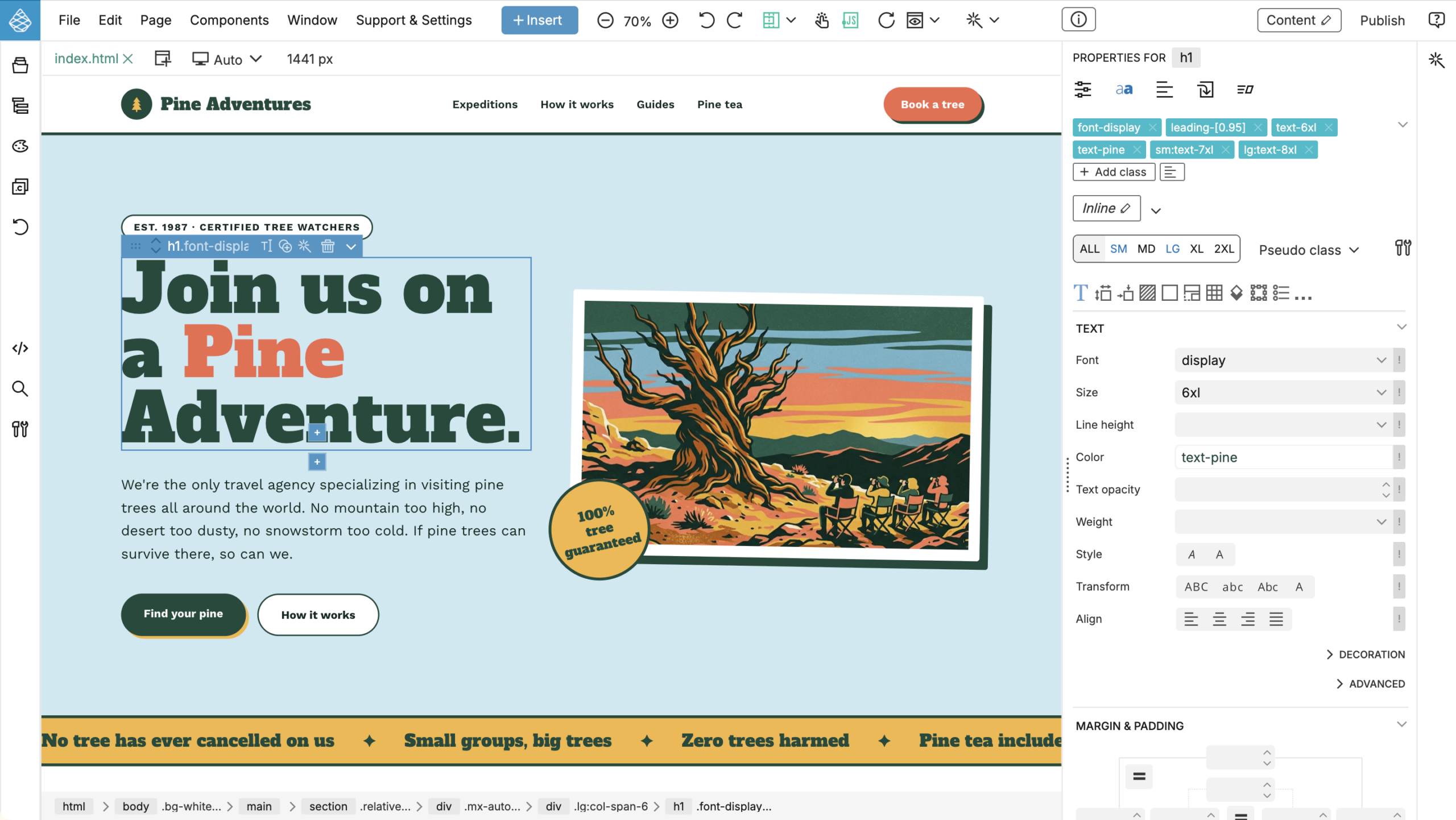
The Tailwind Visual Editor lets you build and edit Tailwind CSS pages in Pinegrow with visual controls instead of typing utility classes by hand. You work on your own HTML files: Pinegrow adds and removes Tailwind classes on the selected element, shows the result in the page view at every breakpoint, and keeps the Tailwind stylesheet of the page up to date.
This documentation is written for Tailwind CSS 4. Pinegrow supports Tailwind CSS 3 too; Working with Tailwind CSS 3 explains what's different.
For an overview of what you can build, see the Tailwind Visual Editor product page.
What you need
- Pinegrow Desktop with the Tailwind Visual Editor add-on. The add-on is included in the free trial. After the trial, your licence must include it. Without the add-on, Pinegrow still opens Tailwind pages, but doesn't show the Tailwind controls.
- Or Pinegrow Online. It has the same Tailwind features as Pinegrow Desktop, except the external build process, which needs Pinegrow Desktop.
Where the Tailwind CSS comes from
A Tailwind page needs a stylesheet with the CSS for the classes it uses. Pinegrow can provide it in three ways:
- The Tailwind CDN script. New Tailwind pages start with a script that builds the CSS in the browser. It's quick for prototypes, but every visitor loads it from the internet.
- The built-in compiler. Activate the Design panel and Pinegrow writes the CSS to
tailwind_theme/tailwind.cssin your project, so the published site doesn't load Tailwind from another server. - Your own build process. Keep compiling with npm or the Tailwind CLI, and edit the pages in Pinegrow Desktop.
Tailwind CSS versions, compiling and offline use explains each option and how to switch from the CDN to a compiled stylesheet before you publish.
Start here
- Create or open a Tailwind CSS project. A new Tailwind CSS 4 project gets a compiled stylesheet right away.
- Read Tailwind CSS versions, compiling and offline use to choose how your pages get their CSS.
- Style elements with the visual controls.
Questions? Tailwind CSS questions and answers answers the common ones.
Pages in this section
Get started
- Introduction to Tailwind CSS: how utility classes work, if Tailwind is new to you.
- Create or open a Tailwind CSS project: start a Tailwind CSS 4 project or open an existing one.
- Activate the Tailwind extension: check that the Tailwind Visual Editor is active on a page, and turn it on by hand.
- Tailwind CSS versions, compiling and offline use: CDN script, built-in compiler or external build, and a site with no Tailwind requests.
- Tailwind CSS questions and answers: short answers with links to the details.
Compile and customize
- Design panel and the built-in compiler: colors, fonts and compiler settings for the whole project.
- Use an external Tailwind CSS build: keep your npm or CLI build and edit the pages in Pinegrow Desktop.
- Match visual controls to a custom theme: show your own colors, fonts and sizes in the controls.
- Upgrade a project from Tailwind CSS 3 to 4: convert the classes of a page or a whole project.
- Working with Tailwind CSS 3: what still applies to Tailwind CSS 3 projects.
Edit and style
- Visual controls: set Tailwind classes with the controls in the Visual controls panel.
- Class Tree inspector: see and edit the classes of an element by breakpoint and state.
- Floating Tools: quick controls next to the selected element.
- Helpers: editing aids for Tailwind pages.
- Styles: reuse sets of classes.
- CSS styling with Component Styles: style components with CSS rules.
Components and learning
- Tailwind Blocks: ready-made sections you can insert into Tailwind CSS 3 and 4 pages.
- Component libraries: use Tailwind component libraries in Pinegrow.
- TailwindUI: use TailwindUI components.
- Tutorials: step-by-step Tailwind projects.
- What's new in the Tailwind Visual Editor: changes by release.